
The Flemish Utility Regulator (Vlaamse Nutsregulator, VNR) warns that the transmission costs paid by grid users in Flanders could rise by about 20 percent in 2027. You cannot change the tariffs. You can change how much power you draw from the grid, and when. That is where your business has leverage.
What is happening?
In early September 2026, the VNR responded to a proposal from the federal regulator CREG. Based on the current tariff proposal from Elia, the operator of the high-voltage grid, transmission costs for grid users in Flanders already rise by about 10 percent in 2027.
CREG also wants to bring forward discounts on transmission tariffs for large industrial consumers with a stable or counter-cyclical consumption profile. These discounts, of 52 and 63.5 percent, were planned for 2028-2031 but would already apply in 2026 and 2027. What those companies no longer pay shifts to the other grid users: households and SMEs on the low- and medium-voltage grid. Together, that brings the increase to about 20 percent.
In the longer term, the VNR expects transmission costs for an average Flemish household to more than triple within ten years.
The VNR sets the 2027 distribution tariffs this autumn. How much ends up on your bill therefore still depends on CREG's decision.
What does this mean for your business?
Grid tariffs are a growing share of your electricity bill, and they rise independently of the price of electricity itself. A cheaper energy contract does not solve that. What you do control:
- How much power you draw from the grid. Every kWh you generate and use yourself does not have to travel over the grid.
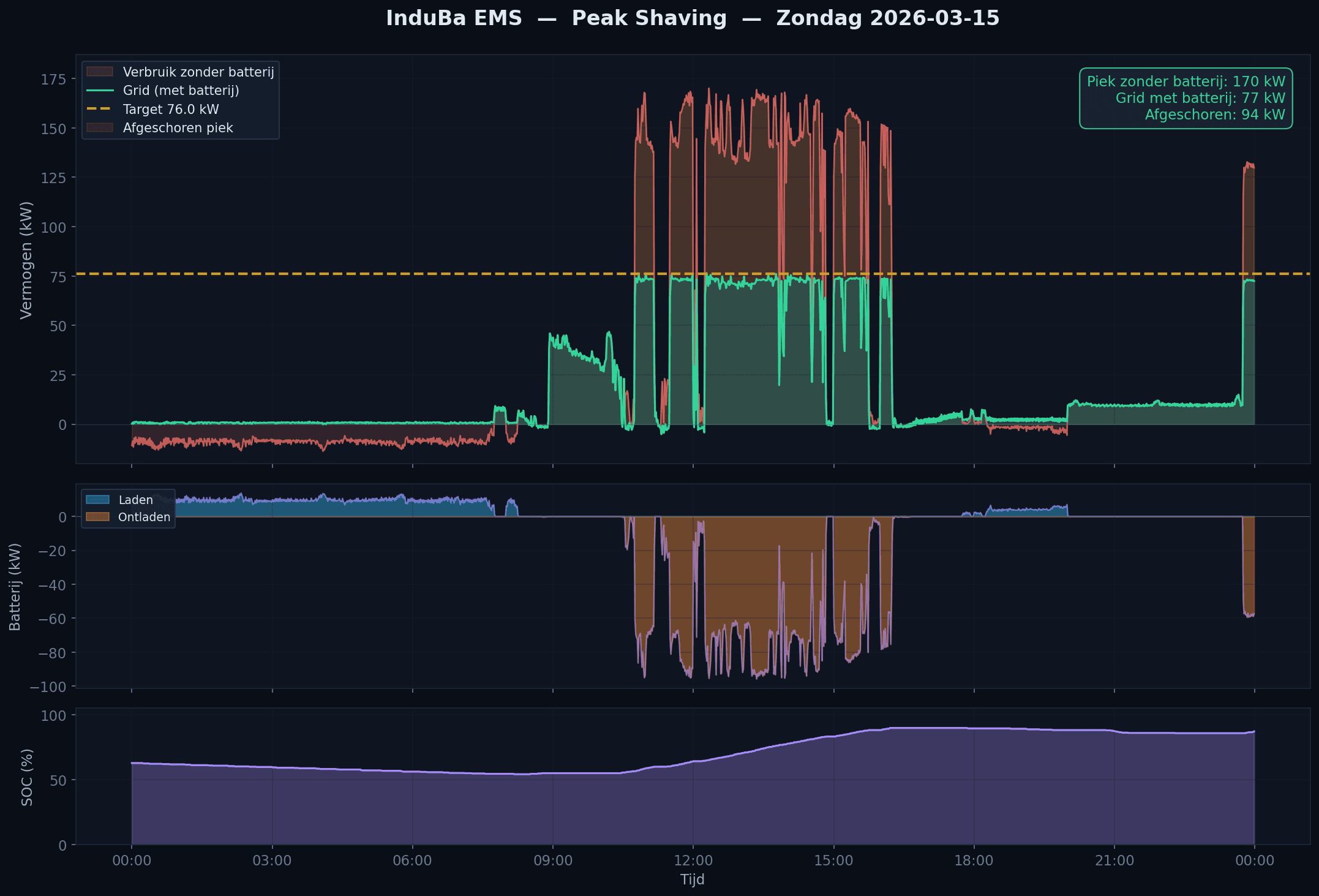
- When you draw it. Under the capacity tariff in Flanders, you pay for your highest quarter-hour peaks. A lower peak means a lower bill, every year.
Meanwhile: electricity at a negative price
On Sunday 26 April 2026, the wholesale electricity price in Belgium fell to −479.27 euros per megawatt hour between 14:00 and 14:15. Electricity had never been this cheap. The cause: plenty of solar power and little demand on a weekend day.
You only benefit from this directly with a dynamic contract. A battery can make use of those cheap hours: charging when power costs almost nothing, and using that power when it is expensive.
What a battery does, and what it doesn't
A battery does not change the tariffs. It changes your consumption profile:
- it flattens your quarter-hour peaks, and with them your capacity tariff;
- it stores your own solar power for later, so you draw less from the grid;
- with a dynamic contract, it charges at the lowest or negative EPEX prices.
Whether that pays off for your business depends on your consumption, your peaks and your solar panels. About 4 in 10 requests turn out not to be profitable, and when that happens, we say so.
What you can do now
- Download your quarter-hour data from Mijn Fluvius. Our guide shows how in 5 steps.
- Send it to us through the upload form. Within 3 working days you get a simulation on your own figures, free and without obligation.
- Prefer to look for yourself first? The free analysis immediately shows your peaks and your capacity tariff.
Frequently asked questions
Will grid tariffs rise in 2027? The Flemish regulator VNR expects transmission costs for grid users in Flanders to rise by about 10 percent in 2027, and by about 20 percent if CREG brings forward the discounts for heavy industry. The 2027 distribution tariffs will be set this autumn.
Does a battery help against higher grid tariffs? Not against the tariffs themselves, but against what you pay. A battery lowers your quarter-hour peaks, and with them your capacity tariff, and how much you draw from the grid. Whether that pays off, we calculate in a simulation on your quarter-hour data.
Who benefits from negative electricity prices? Anyone with a dynamic contract who can shift their consumption, or a battery's charging, to those hours. With a fixed or variable contract, you notice little of it.
Sources
- Solar & Storage Magazine, Vlaamse regulator waarschuwt voor hogere netkosten, mogelijk 20 procent stijging in 2027 (in Dutch), 4 September 2026
- VRT NWS, record-low electricity price on 26 April 2026 (in Dutch)