
Iran War Drives Energy Prices Up: What Does This Mean for Your Business?
Since February 28, the energy market has been in freefall. The war in Iran and the blockade of the Strait of Hormuz have driven European gas prices up by 70% in March. The Dutch TTF gas benchmark doubled to over €60/MWh. Brent crude shot from $60 to above $100 per barrel. This is not a temporary spike. This is the most severe energy disruption since the Russia-Ukraine crisis in 2022.
What happened?
On March 2, Iranian drones attacked Qatari gas facilities. QatarEnergy halted all production and declared force majeure. Qatar supplies approximately 20% of global LNG. That production is gone. The Strait of Hormuz, through which 20% of global oil supply flows, is effectively closed to tanker traffic.
Europe entered 2026 with dangerously low gas reserves. Only 30% full, compared to 60% last year. The ECB raised its inflation forecast for 2026 to 2.6% and postponed rate cuts. Bloomberg calls it an energy shock with echoes of 2022.
Why this hits your business harder than you think
Your electricity bill consists of two components, both rising.
The commodity itself is getting more expensive. Higher gas prices push EPEX day-ahead prices upward. Daytime peaks above €200/MWh are no longer exceptional.
But electricity is not the most expensive line on your bill. Transport is. Here is how that works.
Low voltage (LV) versus medium voltage (MV). Most SMEs are connected at low voltage. Your connection runs through a standard transformer from the grid operator. Larger businesses, a production hall or cold storage facility above 250 kVA, are on medium voltage with their own transformer station. The difference is not just technical. It determines how you pay.
Capacity tariff. Every month, Fluvius measures your highest quarter-hour peak. That is the highest average power over a quarter hour (15 minutes) that you draw from the grid that month. In September it might be 180 kW from your grain dryer. In January perhaps 40 kW. This monthly peak differs every month.
At the end of your billing period, Fluvius takes the 12 monthly peaks and calculates the average. That average is your billing peak. It determines what you pay. For Fluvius Limburg in 2026, that is €49.05 per kW per year. Other Fluvius regions have different amounts.
Calculation example. Your 12 monthly peaks averaged: 100 kW. You pay 100 x €49.05 = €4,905 per year. Pure transport. No electricity. A battery that consistently lowers your monthly peaks to an average of 60 kW saves you €1,962 per year. Every year.
Access power (toegangsvermogen). This applies to larger businesses on medium voltage with their own transformer station. Here you contract a maximum peak power with Fluvius. If you exceed that contractual power, you pay a higher rate per kW per month for every kW above your contract. For medium voltage clients at the distribution cabin, that penalty is €6.39 per kW per month (Fluvius Limburg 2026). The highest monthly peak of the year can also increase your access power for the next 12 months. One bad day, and you pay more for the entire year.
A battery prevents those exceedances. The InduBa EMS keeps your power continuously below the contractual maximum.
Three things you can do today
Spread peaks. Don't start machines simultaneously. Spread the charging of electric vehicles. Schedule processes outside the most expensive hours. This costs nothing but requires discipline.
Increase self-consumption. Do you have solar panels? Consume as much as possible yourself. Every kWh that doesn't come from the grid avoids transport costs. Consider additional PV if your roof allows it.
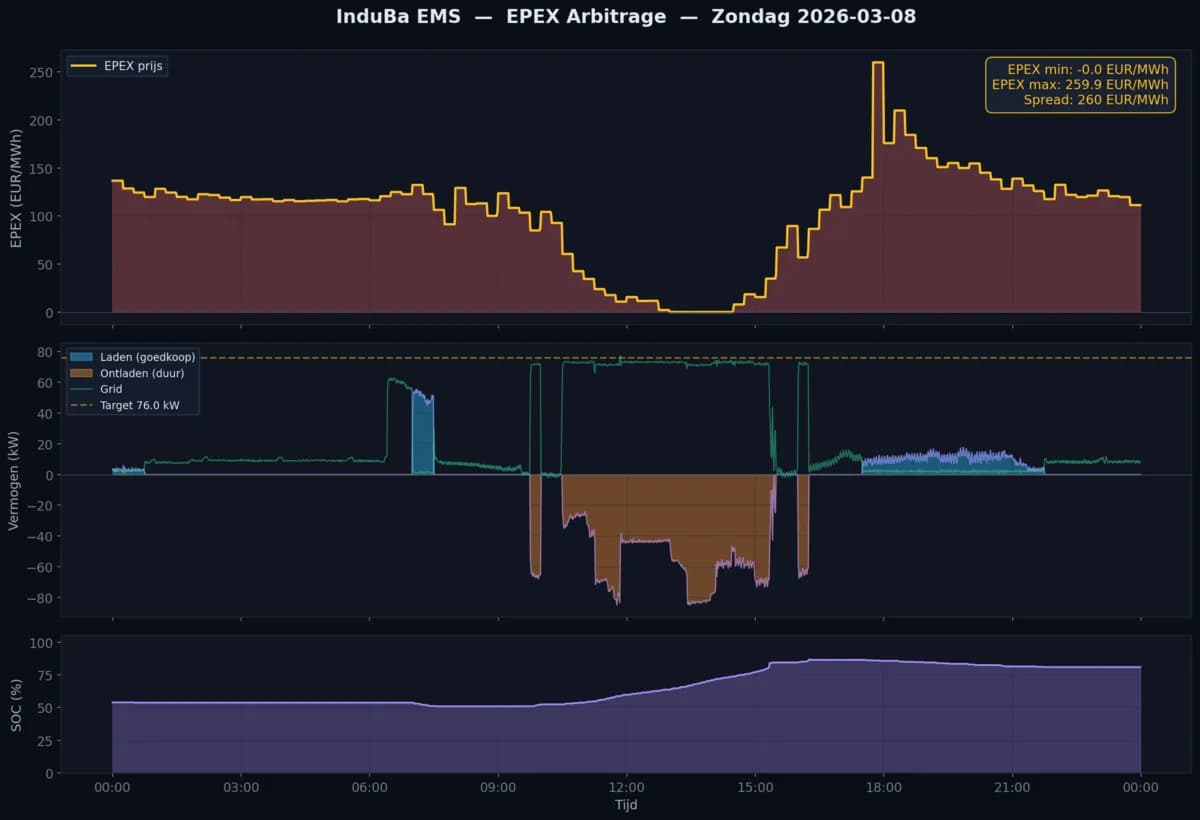
Smart purchasing on the EPEX day-ahead market. Every day at 14:00, EPEX publishes electricity prices for the next 24 hours, per quarter hour. Our EMS analyses these prices, combines them with the weather forecast for your solar panels and the expected consumption pattern of your business, and creates a charging plan. Electricity free due to solar surplus at 13:00? The battery charges. Wind surplus at 03:00 pushing the price to €10/MWh? The battery charges. Price above €150/MWh while your machines are running? The battery discharges. A decision every quarter hour, 96 times per day, fully automatic. Meanwhile the EMS monitors your quarter-hourly peak and prevents your capacity tariff from rising.
What we see at our clients
At Merger BV in Tongeren (Belgium), a 1,032 kWh battery system runs with our own EMS. The system purchases every night at the lowest EPEX price. When prices go negative, the battery charges fully. Free electricity.
During the day, when machines run and prices rise, the battery discharges. The result: the peak dropped from 170 to 85 kW. The capacity tariff is halved.
That is real data from this month. Not theory.
Is this profitable for every business?
No. For 4 out of 10 enquiries, our simulator concludes that a battery is not profitable. We say so honestly. We don't install systems that don't pay for themselves.
The only way to know for your business: a simulation on your actual quarter-hour data. Per quarter hour. Per day. A full year calculated.
Want to find out?
Send your quarter-hour data and latest energy invoice. Within 48 hours you receive a personal business case. Free and without obligation. Even if the answer is no.
Sources: Bruegel analysis (March 2026), Bloomberg Opinion (24 March 2026), CNBC (12 March 2026), Atlantic Council (17 March 2026), EPEX SPOT day-ahead data.